The man after whom the earth itself became safer
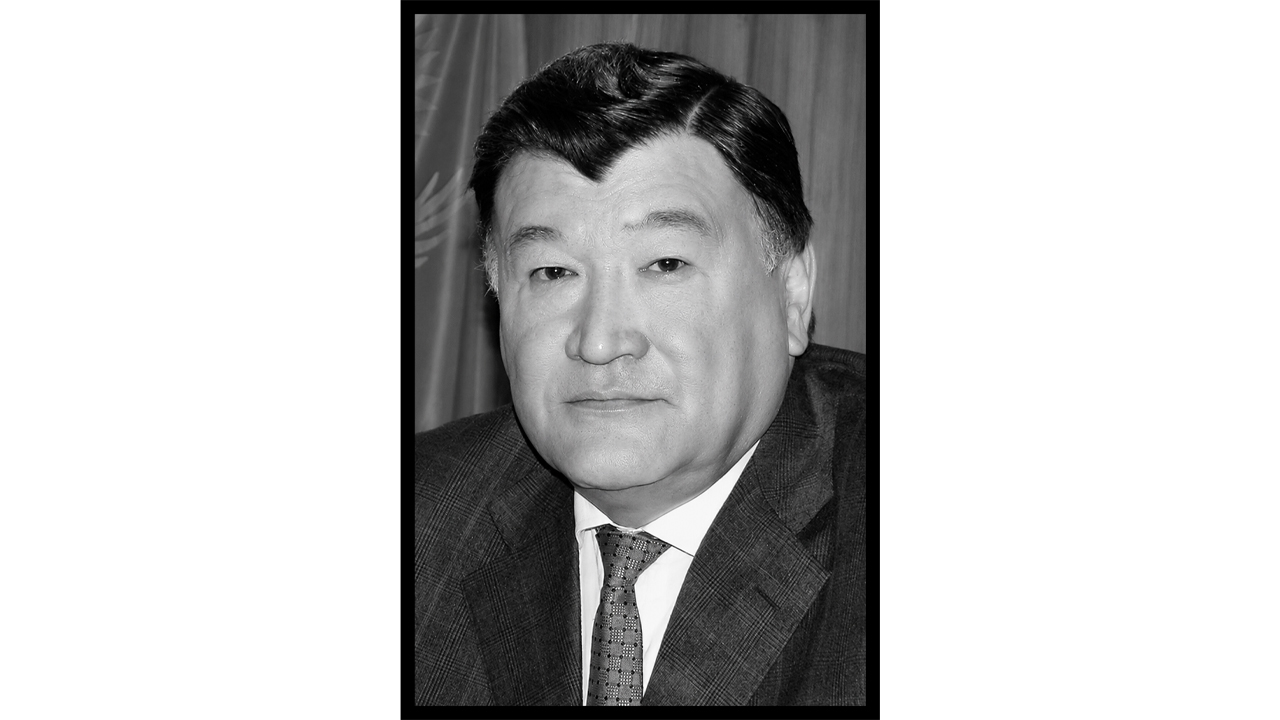
The man after whom the earth itself became safer
Kairat Kamalovich Kadyrzhanov, an outstanding scientist whose life was part of the great history of independent Kazakhstan, has passed away.
...There are people who leave behind books that build cities. They create enterprises....
Kazakhstan says goodbye to just such a person.
Kairat Kamalovich Kadyrzhanov, an outstanding scientist, doctor of physical and mathematical sciences, professor, academician, long-term head of the National Nuclear Center of the Republic of Kazakhstan, one of those people whose life became part of the great history of independent Kazakhstan, has passed away.
For the majority, he was a major scientist, an organizer of science, a laureate of the State Prize of the Republic of Kazakhstan in the field of science and technology, a holder of the Order of “Kurmet”, and a holder of the honorary title “Kazakhstan yenbek sinirgen gylym zhane kairatkeri technician”, awarded to him most recently in recognition of his outstanding contribution to the development of domestic science, nuclear physics and radiation safety.
But all these titles are just official lines in a long biography. The real scale of Kairat Kamalovich is measured differently. He was one of the people who did more than just do science.
He served the country through science.
He belonged to a generation of scientists who had a historical mission - not only to develop the nuclear physics of Kazakhstan, but also to scientifically comprehend one of the most difficult legacies of the 20th century: the Semipalatinsk test site.
For Shakarim University this name has a special meaning.
Our university stands on the land of Abai, where the memory of the word, conscience and responsibility has always been above formality.
But this is also the land next to which nuclear explosions sounded for decades, the pain of which became the pain of the entire country.
And that is why the contribution of Kairat Kamalovich Kadyrzhanov for us is not an abstract page in the history of science, but part of the history of the land itself on which we live, work, teach students, and build the future.
The closure of the Semipalatinsk test site by Decree of President N. Nazarbayev on August 29, 1991 became a historic decision on a global scale.
Kazakhstan has made a choice in favor of peace. But after the political closure, another, no less difficult question remained: what to do with the land on which nuclear tests were carried out for almost forty years?
Where is it really dangerous? What territories can be returned to people? Which areas should remain closed? How to protect the population? How to prevent the threat of proliferation of nuclear materials? How to turn the terrible legacy of the test site into a subject of strict scientific knowledge, and not fear, rumors and speculation?
Only science could answer these questions.
And it was this science that Kairat Kamalovich devoted a significant part of his life.
Since 1997, he has led radioecological studies of the territories of former nuclear test sites and man-made objects in Kazakhstan. Under his leadership, large-scale studies of the Semipalatinsk test site were carried out, the most radiation-hazardous areas were characterized, and approaches to the rehabilitation of the territories and their safe use were determined.
This was work of a special scale: years of expeditions, thousands of measurements, scientific data, a map of the actual radioecological state of the test site, responsibility to the people who live on this land.
He, together with the teams of the National Nuclear Center of the Republic of Kazakhstan, revealed to the world the real radioecological state of the Semipalatinsk test site. He sought the truth and found it.
It was thanks to scientists such as Kairat Kamalovich Kadyrzhanov that the world saw not a mythologized image of the test site, but a scientifically confirmed picture of its condition.
For the Abay region this is of great importance, because we are talking not only about science, but about the right of people to live on their land, develop their economy, build houses, raise children, believe in the future.
In the biography of Kairat Kamalovich there is one more case, which in its scale goes far beyond the borders of Kazakhstan.
This is the final closure of Degelen. What he himself called one of the main affairs of his life.
After the closure of the Semipalatinsk test site in 1991, the nuclear testing infrastructure remained on its territory. Adits, mine sites, test marks, areas with a potential threat of unauthorized access to hazardous materials.
This was a threat not only for Kazakhstan. It was a threat to international security.
In 2013, a unique project that has no analogues in world practice was completed. For 16 years, specialists from Kazakhstan, Russia and the United States carried out the most difficult work to eliminate the nuclear testing infrastructure at the former Semipalatinsk test site.
This is sometimes called a "second landfill closure." The first closure was political and historical. The second is scientific, engineering and civilizational.
And in this second closure a huge role belonged to Kairat Kamalovich Kadyrzhanov.
Under his leadership and with his personal participation, the National Nuclear Center participated in work that made it possible to remove the threats associated with Degelen and Balapan. Protective barriers were created, hazardous facilities were closed, control and monitoring systems were built, and access to areas where the consequences of testing required special protection was limited.
It was a job that few knew about for a long time. A job that required the highest professionalism, trust between countries, discipline, precision and enormous personal responsibility.
Kairat Kamalovich wrote about this calmly, almost restrainedly: “You can really be proud of what was done in Balapan and Degelen.”
This phrase contains his entire character, not the desire to put himself at the center of history, but only the dignity of a man who knew the value of the work done.
And the price of this matter is enormous, because after such people it is not the office, not the laboratory, not just one city that becomes safer, but the earth itself becomes safer.
Kairat Kadyrzhanov was a scientist of rare caliber.
He graduated from the Moscow Engineering Physics Institute with a degree in solid state physics, and completed an internship and postgraduate studies at the I.V. Kurchatov Institute of Atomic Energy under the guidance of Academician I.K. Kikoin.
Since 1978, his life has been connected with the Institute of Nuclear Physics of the Academy of Sciences of the Kazakh SSR. In 1985, he organized and headed the laboratory of metal ion implantation. In 1993 he defended his doctoral dissertation in solid state physics. Later he became director of the Institute of Nuclear Physics of the National Nuclear Center of the Republic of Kazakhstan, then general director of the National Nuclear Center of the Republic of Kazakhstan.
He was an expert in solid state radiation physics, radiation materials science, ion implantation, ion plasma deposition, radiation ecology and high-tech nuclear technologies.
Under his leadership, a new scientific direction was created and developed - the thermodynamics of alloys with an inhomogeneous phase-structural state.
He solved applied problems related to the creation of the Argamak ion-plasma installation, coating technologies, the production of beryllium coatings and foils, and the development of radiation-resistant materials.
But something else is important. He knew how to combine fundamental science with the tasks of the state. This is where the scale of a true scientist is revealed.
He understood that nuclear physics is not only formulas, installations, reactors and publications. These are energy security, medicine, ecology, international responsibility, personnel training, that is, the future of the country.
On his initiative, the creation of an interdisciplinary research complex based on the DC-60 heavy ion accelerator began at the Eurasian National University named after L. N. Gumilyov, which became not just a scientific installation, but a space for training young physicists, developing research, and forming a new scientific environment.
On his initiative, a project was launched at the Institute of Nuclear Physics to create a Center for Nuclear Medicine in Kazakhstan - an area vital for the diagnosis and treatment of serious diseases.
He developed the production of radioisotope products and radiopharmaceuticals necessary for medicine, and created not only scientific results. He created the infrastructure of the future.
Kairat Kamalovich was not only a scientist. He was a Teacher because he belonged to those people around whom young researchers began to understand that science is not a profession for a few years, it is destiny.
He educated nuclear physicists, developed international cooperation, connected Kazakhstan with the leading scientific centers of the world, and stood at the origins of educational programs that made it possible to train world-class specialists.
It is precisely such people who create a scientific school through personal example, exactingness, decency, inner strength, and state thinking.
In one of his memoirs, Kairat Kamalovich said that the first lesson in the state approach was given to him by his father, Kamal Kadyrzhanovich Kadyrzhanov, a man who put the interests of the state above personal ones.
He carried the lesson throughout his life, so his biography is not only the path of a talented physicist. This is the path of a man for whom serving the country was a natural state.
He belonged to a rare type of people who do not separate personal fate from the fate of the state. It is precisely such people that the country especially needs in critical epochs.
In the 1990s, when Kazakhstan was just forming its own statehood, when it was necessary to make decisions about the nuclear legacy, security, international trust, scientific infrastructure and the future of the nuclear industry, people not of big words, but of big deeds came to the fore.
Kairat Kadyrzhanov was one of them. A strong man. Strong scientist. Strong organizer.
A person capable of going where others were afraid to even look, who saw not only the danger, but also the solution, not only the past, but also the future, not only the problem, but also the responsibility.
Today the scientific community of Kazakhstan has lost an outstanding physicist.
National Nuclear Center - its long-term leader
Students - Teachers. Family - a loved one.
But the country has lost much more.
Kazakhstan has lost a man who proved with his whole life: great states are created not only by political decisions. They are created by people who take on the most difficult parts of history.
People who have been working for decades where there is risk, responsibility and duty.
Shakarim University expresses deep condolences to the family and friends of Kairat Kamalovich Kadyrzhanov, the country's scientific community, his colleagues and students.
For our university, the memory of him is the memory of a person whose work is directly related to the fate of the land of Abay, which survived the tragedy of the testing site, where today the voices of students are heard, laboratories are built, new scientific ideas are born and the path of knowledge continues.
Kairat Kamalovich Kadyrzhanov left behind not only his works, awards and positions.
He left an example of the highest intellect, moral strength, and public service.
An example of a scientist, after whom the earth itself became safer.
Happy memory to an outstanding Scientist.
Happy memory to a man who was and remains a big part of the history of Kazakhstan.