Askar Kasymov, Vice-Rector for Strategy and Social and Civil Development Shakarim University: Infrastructure as a strategy. Personnel as a result.
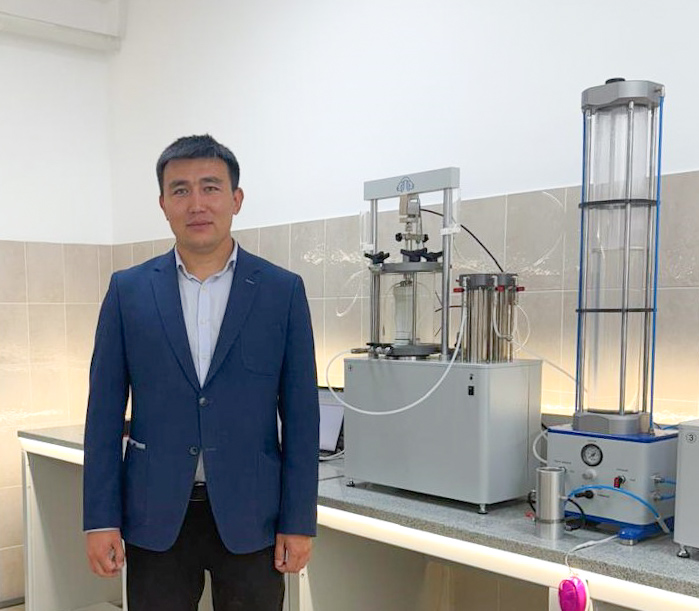
The reason for this interview was the opening of two new laboratories at the Department of Geodesy and Construction of Shakarim University: geotechnical and building materials laboratory. The event is also a certain stage of the strategic agenda, towards which the university moved step by step and systematically. That is why the interview with takes on special significance as a look at what is happening from the position of step-by-step movement forward.
The development of university infrastructure is seen as a systemic strategic process in which the material and technical base becomes the foundation of the educational and scientific ecosystem. Especially when it comes to training engineering personnel who are ready to immediately get involved in production and research processes. In engineering fields it is impossible to prepare a professional “in theory”. All key competencies: from design thinking to analytics skills must be developed in contact with real equipment, close to what graduates will encounter in a production environment. But there is only one side to this.
On the other hand, the equipment purchased today at the university cannot be considered as “just simulators” for future specialists. It is universal in its purpose. It can be used to conduct scientific research, perform applied tasks, generate scientific articles and technical solutions, which subsequently become part of the development of the region and the country.
Over the past year, thanks to investments in scientific infrastructure, we have observed a qualitative increase in the scientific potential of the university. This is reflected not only in an increase in the number of scientific publications, but also in the fact that we consistently win and implement scientific projects. Moreover, these are not isolated successes, but already stable dynamics. If previously equipment was purchased primarily at the expense of internal funds of Shakarim University, today we can say that up to 80%, and for certain items and higher, is purchased through attracted scientific grants.
A sustainable cycle has been launched: infrastructure gives impetus to science, science generates projects, projects provide funding, funding strengthens infrastructure. This mechanism needs to be maintained and developed. It is already bearing real fruit.
Particularly worth noting are the changes in personnel composition. In the recent past, we often talked about the generation gap, about the fact that the older generation of scientists is gradually completing their active work, and the new one has not yet entered into full force. Today we see how this barrier has been overcome.
Young PhD researchers who defended themselves 5–10 years ago became mentors themselves. They launch their own research teams, take out grants, lead projects, and train students not only as teachers, but also as scientific supervisors. This is the basis of scientific continuity, which was previously formed spontaneously, but today it is systemic.
In the university strategy, these processes are recorded as priorities. We clearly understand that the sustainable development of a scientific school is impossible without a modern laboratory base, an established system of grant participation, commercialization mechanisms, and a mentoring school in which young personnel are embedded.
We need, while meeting educational standards, to learn to get ahead of them, which is especially important in the context of global transformations: the transition to a green economy, digital engineering solutions, bio- and agricultural technologies. In these areas, Shakarim University is already forming its own tracks and expert teams.
Now we are faced with the task of not stopping at relative stability, but moving on to the phase of forming interdisciplinary centers, creating conditions for intraregional and international scientific partnerships, integrating science into the knowledge economy of the region, and providing full support for student startups developed in these laboratories.
Shakarim University becomes a platform where the strategy, science and personal history of each researcher, student, teacher are combined into a single development space that creates value and perspective both for the university itself and for the entire region, and, therefore, the country as a whole.